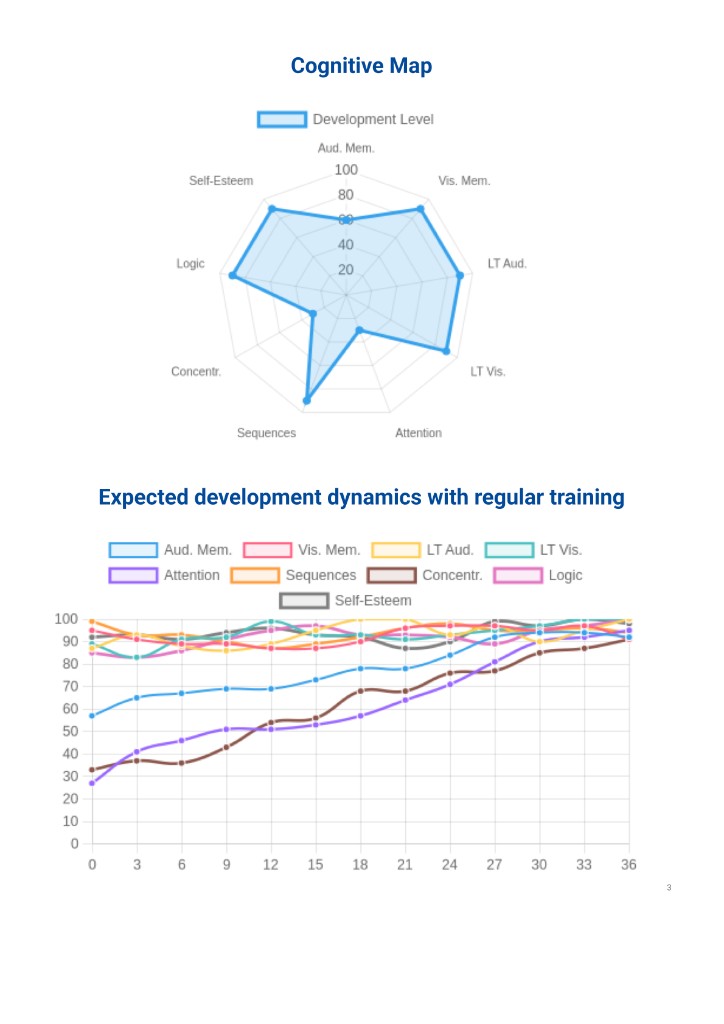
An interactive system that measures the development of a child's cognitive abilities and displays their progress in clear graphs and reports for parents and educators.
Request a Demo (15 min)They measure key cognitive skills:
Attention and concentration
Memory
Logical and abstract thinking
Information processing speed
Executive functions: the child's ability to perceive commands, plan actions, and control themselves (Spatial reasoning)
Self-esteem and reflection
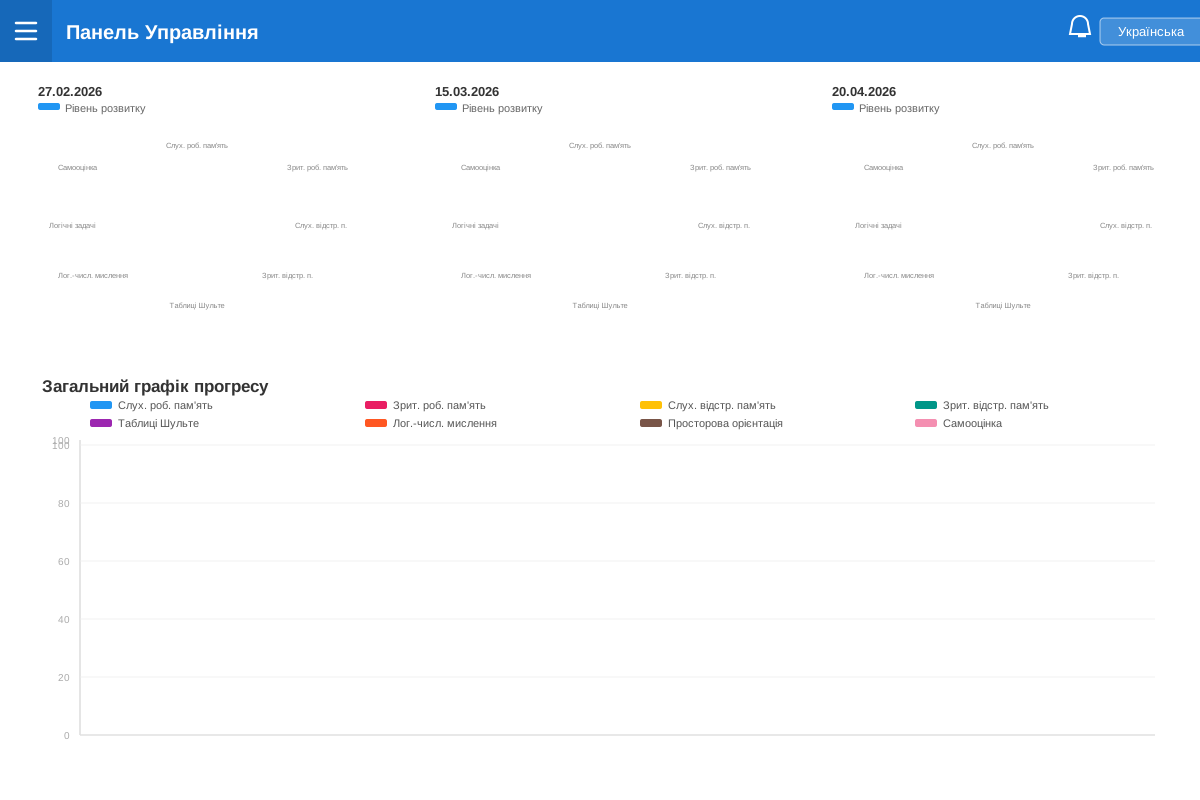
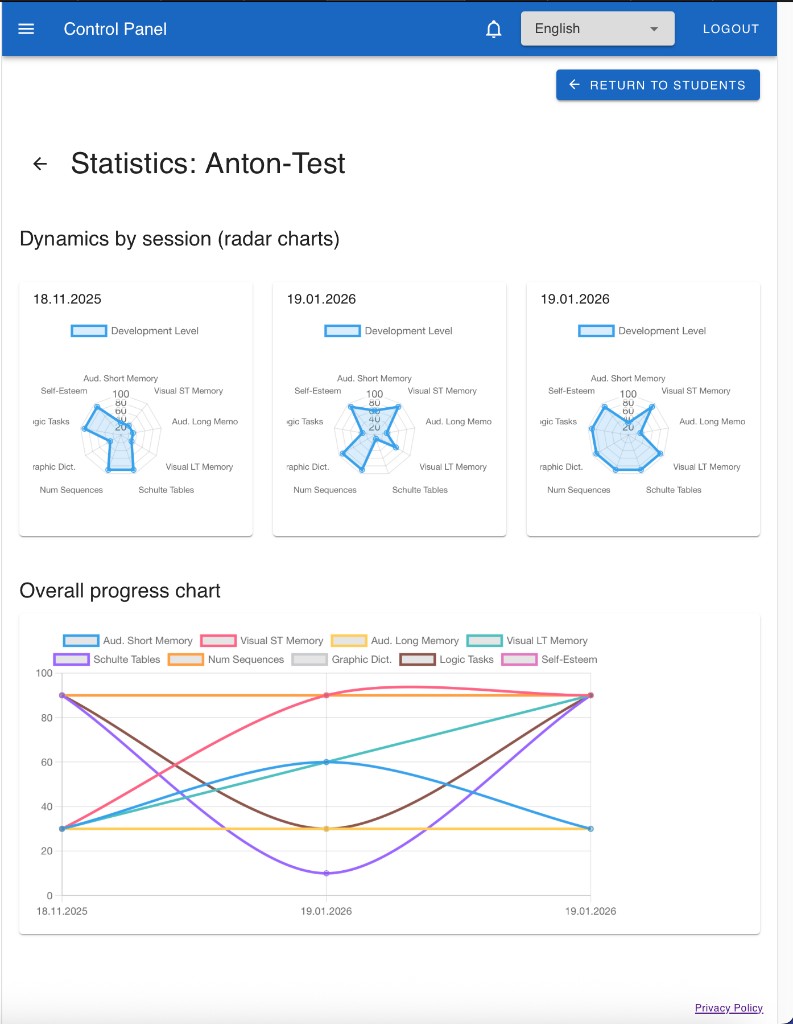
The system analyzes the results and shows them in the form of clear graphs and reports so that parents and educators can see the real progress of the child's development.
Thanks to this, parents and educators can see:
This allows discussing the child's development not on the level of subjective impressions, but based on real measurable data.
Parents don't see instant results and stop paying after 2-3 months. A subjective "your child is doing great" is no longer enough to renew a subscription.
You provide them with visual reports showing real developmental dynamics. Parents see progress in numbers and stay with you for years.
The level of teaching varies from teacher to teacher. You lack a unified standard for quality control across different branches or groups.
Objective quality control of teaching. You manage the process based on numbers, not emotions or impressions.
Acquiring a new client is more expensive than retaining an existing one. Furthermore, you lose the opportunity for upselling within the school.
You earn additional income from testing (as a separate paid service) or integrate it into your standard curriculum, which significantly increases the value of your educational product. Plus, based on objective data, you can reasonably offer parents additional courses for the development and correction of specific abilities that the child lacks.
According to PISA data, knowledge retention levels are declining. Furthermore, standard teaching methods often fail because they do not account for the neurofunctional characteristics of today's children.
The platform reveals the cognitive reasons behind academic struggles. You gain data for proper inclusion and a personalized approach, helping the educator teach the child based on their strengths.
Everyone around promises abstract "development".
NeuroEducatimo becomes your unique product and competitive advantage. You are the only ones proving results with measurements.
Scalable monitoring. You can clearly see on graphs which methodology works best for specific age groups of children.
4 simple steps
Importing student data into the system and setting up a profile.
The child completes an engaging test on a tablet without any stress.
The system instantly generates a detailed report for the school.
You demonstrate objective results and dynamics to the parents.
Track the cognitive progress of each child and group throughout the learning process. Compare "before" and "after" results and see the real impact of your methodologies.
Evaluate the effectiveness of each teacher and methodology using a single objective algorithm. No subjective reports — only data.
Watch a short video to learn how our platform helps digitize and visualize children's cognitive progress, making the learning process transparent and effective.
In this video you will see:
Why are customers leaving even good centers? Because the words: "Your child is doing well" are no longer enough.
Parents want to see the results they are paying for. Neuro Educatimo is the first SaaS platform for evidence-based cognitive function diagnostics.
Make your child's progress visible and understandable. It's simple. The teacher registers the student, and the child takes an exciting test on a tablet.
No stress or boring exams, under the guidance of a specialist from your organization. The test results are sent to the server.
The system instantly analyzes brain parameters and builds an accurate cognitive profile of the student. You see not just a snapshot, but dynamics.
Real progress over three months or a year. This is proof of the effectiveness of your classes. Our partners can see all the testing sessions conducted for their students, group them by field of study or age, add and edit specialists from their organization who are involved in conducting and analyzing tests.
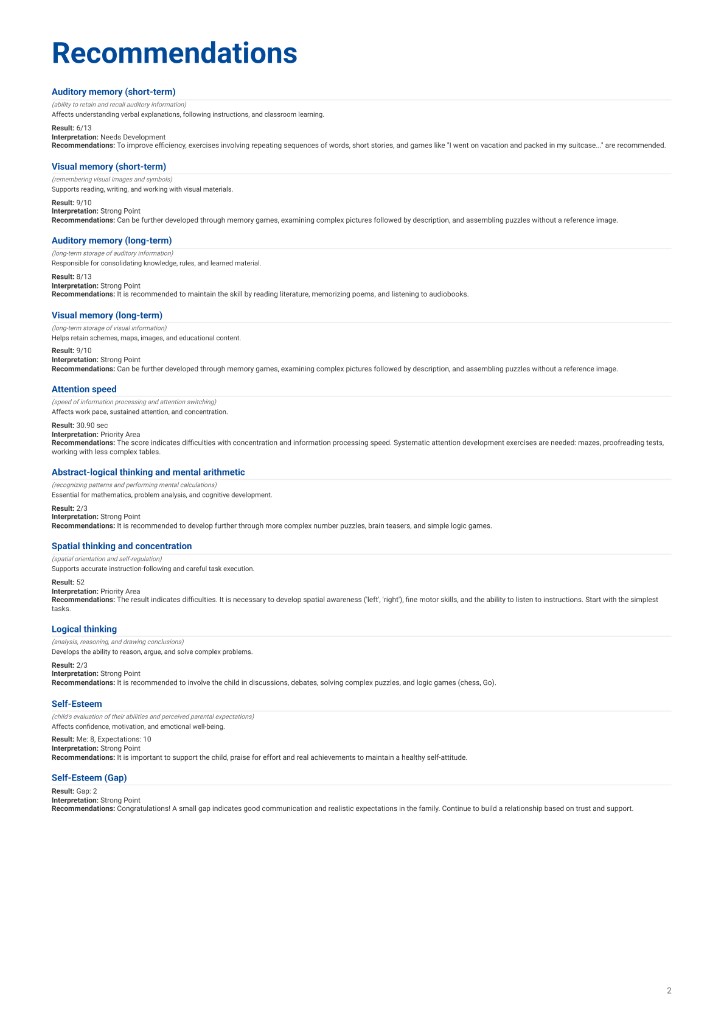
Download professional reports with your logo, details, and a description of your specific methods. This works to build your brand's credibility.
Introduce diagnostics as a paid service. Increase customer LTV and parent trust, based on solid data.
Neuro Educatimo: results you can measure. Sign up and get 7 days of free access.
What your center and parents receive
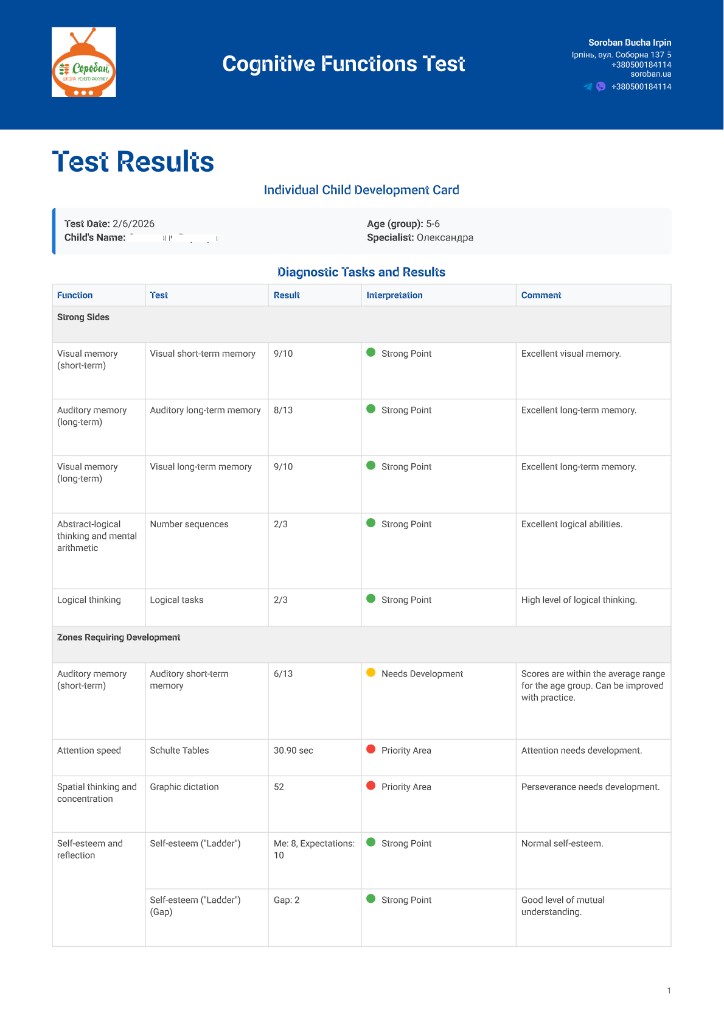
A report with the child's cognitive profile — under your school's brand. A teacher dashboard with each student's development dynamics.
Neuro Educatimo offers a comprehensive set of tools for the comprehensive analysis and support of every child's cognitive development.
Resource saving. One tool replaces a staff of diagnosticians. 10 years of methodist experience packed into an algorithm: The system analyzes brain parameters faster and more accurately than a human expert.
Parents who see growth figures do not take their child out of school. You extend the client life cycle for years by showing them irrefutable progress charts, not just words.
Correction 'on the fly'. See a group dip? Adjust the methodology. The system allows you to identify 'weak links' in teaching and staff based on objective data.
Become the first Evidence-Based Center in your city. Sell a premium product to parents investing in their children's future. This is an argument competitors have no answer to.
Turn testing into a separate paid service. Entrance diagnostics for new students, regular check-ups, or services for summer camps provide additional income that covers the platform subscription from the very first clients.
Find the key to "difficult" children. When standard methods fail, the platform reveals the true cognitive reason behind academic struggles. You gain the foundation to build a personalized learning path for each student.
Our platform is the ideal tool for those striving for innovation and an evidence base in education.
Attract more clients by demonstrating measurable results of their children's development. Strengthen your brand as a center using advanced, scientifically based methods.
Integrate deep analysis of cognitive functions into the learning process. Help students unlock their potential and increase the academic performance of the entire institution.
Get a powerful tool for personalizing learning. Create individual development programs based on accurate data about each student.
Deepen your diagnostics and therapy tracking. Visualize changes in cognitive functions, confirming the effectiveness of your work.
Our platform does not use random exercises or tasks "invented from scratch". It is built on time-tested approaches that have been used for decades in neuropsychology, child psychology, and pedagogical diagnostics. We use our own digital tasks, specially adapted for the online format and different age groups, but their diagnostic logic is based on classic approaches to evaluating children's memory, attention, thinking, self-regulation, and self-esteem. During development, we focused on internationally recognized assessment trends, represented in particular by the approaches of David Wechsler, A. R. Luria, Marit Korkman, Ursula Kirk, Sally Kemp, Walter Schulte, and D. B. Elkonin.
Neuro Educatimo is created by a team of experts in cognitive psychology and IT. We care about evidence and effectiveness.
Behind this product lies 10 years of managing a network of educational centers and thousands of graduates. We are not an IT startup deciding to 'play school.' We created Neuro.Educatimo because there was no effective tool on the market capable of measuring a child's brain efficiency and tracking its dynamics. We digitized classic neuropsychological test batteries and taught the system to see what the teacher's eye misses. This is a standard proven on real children.
Find out more about the teamGet quick answers to the most common questions about the Neuro Educatimo platform.
No. The system is designed so that any teacher or administrator can conduct testing after a short briefing. The algorithm handles the interpretation. You get a ready-made report.
It is a SaaS platform for educational centers that digitizes, visualizes, and analyzes children's cognitive development (attention, memory, thinking) based on standardized tests, helping educators demonstrate measurable progress.
Neuro Educatimo is ideal for private educational centers, schools, gymnasiums, individual educators, and neuropsychological centers striving for an evidence-based, scientifically sound approach to education.
The platform transforms raw testing data into intuitive charts and reports. You can visually show parents the dynamics of their child's cognitive functions, confirming the effectiveness of your sessions with objective data.
Unlike traditional tests that only provide a final score, Neuro Educatimo analyzes detailed raw data (e.g., reaction time, number of errors) and visualizes it, offering personalized recommendations for developing specific cognitive skills.
The platform is intended for the educational monitoring of cognitive skills and is not a medical or clinical diagnostic tool.
Auditory Verbal Memory
The tasks in this block assess how a child perceives verbal information by ear, holds it in short-term memory, and reproduces it immediately after presentation. In its diagnostic principle, this format is close to the classic approaches of evaluating auditory-verbal memory used in the Wechsler memory scales and the Lurian neuropsychological tradition.
Visual-Verbal Memory
This block evaluates the child's ability to memorize visual images and associate them with words. Such tasks are linked to basic learning mechanisms — recognition, association, and the rapid formation of new connections. According to the evaluation logic, this type of task is close to the Memory and Learning domain in the NEPSY-II battery, which includes subtasks for memorizing images, names, and lists.
Long-term Auditory Memory
After a pause, the child must recall the verbal material that was presented earlier. This allows for assessing not only immediate memorization but also the strength of information retention in memory. This principle of delayed recall is classic for neuropsychological memory assessment.
Long-term Visual Memory
This block tests how well a child retains and recognizes visual images after a certain period. This is important for learning, reading, and orienting in symbols, shapes, and visual templates. By diagnostic logic, the block is close to the visual tasks of the Memory and Learning domain in NEPSY-II.
Schulte Tables
The platform uses a digital adaptation of Schulte tables for different age groups — 3×3, 4×4, 5×5, and 6×6. The methodology is traditionally associated with the German psychiatrist Walter Schulte and is used to assess the speed of visual search, concentration, and sustained attention.
Number Sequences
Proprietary tasks on numerical patterns assess the child's ability to notice a rule, hold it in working memory, and logically continue the series. Such tasks are associated with the assessment of inductive reasoning, working memory, and mathematical reasoning ability — cognitive domains that are also reflected in the Wechsler scales.
Graphic Dictation
Tasks of this type rely on classic approaches to evaluating spatial thinking, auditory-motor coordination, voluntary regulation, and the ability to follow instructions. In educational psychology and school readiness diagnostics, this area is traditionally associated with the works of D. B. Elkonin.
Logic Tasks
The logic tasks block evaluates cause-and-effect thinking, the ability to notice connections, draw conclusions, and generalize. This is one of the basic components of cognitive maturity, which is widely represented in classic approaches to assessing intelligence and school readiness.
Self-esteem and Reflection
This block helps to see how the child perceives themselves, their capabilities, and their place among others. On a theoretical basis, such tasks are close to classic ideas about the formation of the "Self-image" in interaction with others, in particular, the ideas of Charles Horton Cooley and George Herbert Mead regarding the social origin of self-esteem.
Read our articles on cognitive development, teaching methodologies, and neuropsychology.
Be one of the first to gain access to Neuro Educatimo. Join the pilot program to test the platform for free and help shape its development.